
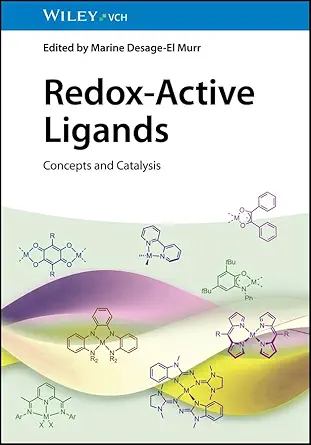
eBook For Redox Active Ligands Concepts and Catalysis 1st Edition By Desage-El Murr Marine
- ISBN-13 : 978-3527830886
Why Choose US?
- This product is a digital eBook. It is not a printed book. No item will be sent to your home.
- After you buy, you will get a file that you can download right away. You can open and read the eBook on your phone, tablet, laptop, or computer.
- Our digital books are easy to download and simple to use. You can save the file and read it anytime you want.
- If you have any problems with your download, please contact us. Our support team is available all day and night to help you.
- If you cannot find the eBook you need in our store, please contact us. We’ll find that book for you and arrange it as soon as possible.
- Thank you for visiting our store and choosing our digital products. Enjoy your reading.
Table of Contents
Preface xi
Part I Introduction and Concepts 1
1 Anatomy of a Redox-Active Ligand 3
Marine Desage-El Murr
1.1 Introduction 3
1.2 Biological Inspiration: From the Enzyme to the Flask, a Continued Journey 4
1.3 Chemical History: Puzzle-Solving for Coordination Chemists 6
1.4 Combining Spectroscopy and Theory: How to Spot a Redox-Active Ligand? 9
1.5 Non-innocent, Cooperative, Electro-Active, or Redox-Active? 10
1.6 Unusual Ligands and Unusual Reactivities with a Redox-Active Ligand 12
1.7 Perspectives and Concluding Remarks 15
2 Mechanistic Studies of Catalytic Nitrene-Transfer Reactions Involving Redox-Active Ligands and Substrates 21
Nicolaas P. van Leest, Jarl Ivar van der Vlugt, and Bas de Bruin
2.1 Introduction 21
2.2 Characterization of Radical-type Intermediates 23
2.3 Mechanistic Studies 29
2.4 Case Studies for Nitrene Transfer Aided by Redox-Active Ligands and Substrates 33
3 Redox-Active Ligands From a Computational Perspective 53
Roy Eckhardt, Dorys Reyes, Christian Sandoval-Pauker, and Balazs Pinter
3.1 Introduction 53
3.2 Electronic Structure Determination Through DFT and Spectroscopy 55
3.3 Redox-Active Ligands as Electron Reservoirs 63
3.4 In Silico Description and Engineering of Redox-Active Ligands 84
3.5 Conclusions 98
Part II Applications 107
4 Complexes of Stable N-aryl Radicals and Their Catalytic Applications 109
Nicolas Leconte and Fabrice Thomas
4.1 Introduction and General Considerations on Exocyclic N-aryl Radicals 109
4.2 Complexes Featuring Anilinyl Radicals 111
4.3 Bidentate o-diaminobenzenes and Their Radicals 115
4.4 Pincer Ligands and Their Radicals 124
4.5 Branched Tetradentate o-diaminobenzene and Associated Radicals 128
4.6 Polydentate Ligands Featuring One Bidentate Diiminosemiquinone Radical 130
4.7 Representative Catalytic Applications 135
4.8 Conclusion 140
5 Redox-Active Ligands in Coordination Chemistry and Organic Synthesis 151
Toru Amaya, Toshiyuki Moriuchi, and Toshikazu Hirao
5.1 Introduction 151
5.2 Controlled Formation of Conjugated Complexes with Redox-Active Polyanilines or 1,4-Benzoquinonediimines 152
5.3 Catalytic Application of Hybrid Systems Consisting of Redox-Active Polyanilines and Transition Metals 162
5.4 Conclusion 169
6 Metal Complexes Bearing Redox-Active Supporting Ligands that Promote Chemical Transformations Involving Protons and Electrons 175
Kundan K. Singh and Isaac Garcia-Bosch
6.1 Introduction 175
6.2 Dioxygen Reduction toWater 177
6.3 Dioxygen Reduction Coupled with Substrate Dehydrogenation 179
6.4 Dioxygen Reduction Coupled with Substrate Hydroxylation 187
6.5 Conclusions and Future Perspectives 192
Part III Case Studies 197
7 Redox-Active Guanidine Ligands 199
Hans-Jörg Himmel
7.1 Introduction 199
7.2 Properties and Reactivity of Uncoordinated Redox-Active Guanidines 200
7.3 Redox-Active Guanidines as Ligands in Coordination Chemistry 206
7.4 Perspectives 241
8 Coordination Chemistry with Lanthanides and Redox-Active Ligands 249
Valeriu Cemortan and Grégory Nocton
8.1 Introduction 249
8.2 Quinone, Iminoquinone, and O-phenylenediamine-Based Complexes 250
8.3 Diazadienes 262
8.4 Iminopyridines and Bis(imino)pyridines 271
8.5 Nitroxides 277
8.6 N-heterocycles 280
8.7 Conclusion and Outlook 299
9 Actinide Complexes of Redox Non-innocent Ligands 317
Karlotta van Rees and Jason B. Love
9.1 Bipyridyl Ligands 318
9.2 Pyrrole Ligands 320
9.3 Tmtaa Ligand 323
9.4 Schiff-Base Ligands 324
9.5 Pyridine(di-imine) Ligands 329
9.6 Phosphite Ligands 332
9.7 Quinone Ligands 332
9.8 Aryloxide Ligands 335
9.9 Conclusion 338
References 339
Index 343








Reviews
There are no reviews yet.