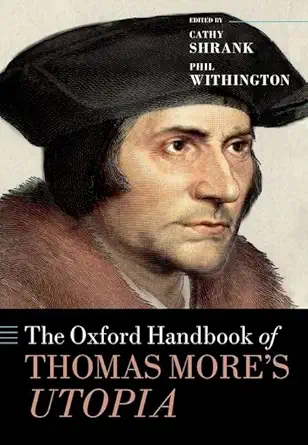
Introduction to Thomas More’s Utopia, Phil Withington and Cathy Shrank
Part One: Origins and Contexts
1:More and the Republics of Plato, Angie Hobbs
2:Hythloday’s Books: Utopia, Humanism, and the Republic of Letters, Carla Suthren
3:Nec minus salutaris quam festivus: Wit, Style, and the Body in More’s Utopia, Andrew Zurcher
4:The Religions of the Utopians: Sin and Salvation in Thomas More’s Utopia, David Harris Sacks
5: ‘ Nothing is private anywhere’: Utopia in the context of More’s thought, Joanne Paul
6:Utopia and Travel Writing, Andrew Hadfield
7:Utopia’s Empire: Thomas More’s Text and the Early British Atlantic World, c. 1510-1625, Jessica S. Hower
8:The Urban Context for Utopia: The English Urban System, 1450-1516, Eliza Hartrich
9:Utopia Unbound: The Fabrication of the First Latin Editions, 1516-1519, Andrew Taylor
Part Two: Translations and Editions, 1524-1799
10:ad fontes et ad futurum: A Survey of Latin Utopias, Lucy Nicholas
11:From Prototype to Genre: Translations and Imitations of Utopia in Early Modern Germany (1524-1753), Gabriela Schmidt
12:Receiving More: Utopia in Spain and New Spain, Darcy Kern
13:Utopia in Sixteenth-Century Italy, Cathy Shrank
14:Inventing Utopia: The Case of Early Modern France, Richard Scholar
15:Utopia in Tudor London: Ralph Robinson’s Translations and their Civic, Personal, and Political Contexts, Jennifer Bishop
16:Dialogue, Debate, and Orality in Ralph Robinson’s Utopias, Dermot Cavanagh
17:’Het onbekent en wonderlijk Eyland’: Frans van Hoogstraten’s translation of Utopia (1677), Wiep van Bunge
18:Utopia and Gilbert Burnet in 1684, Phil Withington
19:From Humanism to Enlightenment: Nicolas Gueudeville and his Translation of Thomas More’s Utopia, Floris Verhaart
20:Thomas Rousseau, Translator of an Enlightened Utopia, Katherine Astbury
Part Three: Translations and Editions after 1800
21:False Friends (and their Uses): Thomas More’s Utopia Among the Victorians, Marcus Waithe
22:The Cultural Politics of Translation: Translating Thomas More’s Utopia into German in the Late Nineteenth Century, Janet Stewart
23:Not Just a Light-Hearted Joke: Russian Moreana from the Age of Karamzin to the Rise of Social Democracy and Lenin’s ‘Stele of Freedom’, Frances Nethercott
24:Utopia in Eastern Central Europe: The Hungarian Scene, Zsolt Czigányik
25:A Catalan in Search of Humanists: Josep Pin i Soler’s Translation of More’s Utopia (1912), Louise Johnson
26:The Historical Fallacy: Utopia and the Problem of Fiction in Weimar Germany, Cat Moir
27:Japanese Translations of More’s Utopia, Teruhito Sako
28:The Multiple Lives of Utopia in Modern China, Tehyun Ma
29:Utopia and Utopian Writing in Arabic, Peter Hill
Part Four: Beyond Utopia
30:Early Modern Utopian Fiction: Utopia and The Isle of Pines, Chloë Houston
31:Of Survival and Living Together: The Eighteenth-Century Utopian Novel, Nicole Pohl
32:Conversation, Formation, and Forms of Utopia in Fin-de-Siècle Socialist Journals, Ingrid Hanson
33:Utopia, the Imperial Settler Utopia, and Imperial Settler Science Fiction, Rebecca Weaver-Hightower and Musab Bajaber
34:Away from the Ancestral Home: Utopia and Philosophy in Bloch and Beyond, Johan Siebers
35:Human Rights and/in Utopia?, Miguel Angel Ramiro Avilés
36:Utopia and Moral Economy, Martin Lutz
37:Utopia and Architecture, Diane Morgan
38:Mapping Utopia, Alfred Hiatt
39:Contemporary Utopianism: An Island Renaissance, Rhys Williams
Appendix A: Outline of More’s Utopia
Bibliography







Reviews
There are no reviews yet.