
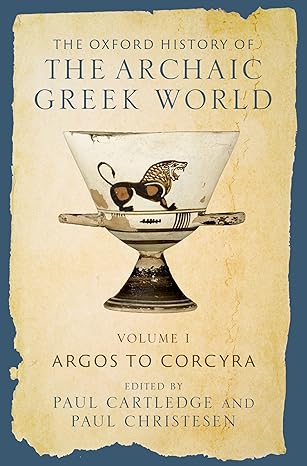


eBook For The Oxford History of the Archaic Greek World Volume I Argos to Corcyra 1st Edition By Paul Cartledge
Why Choose US?
This product is a digital eBook. It is not a printed book. No item will be sent to your home.
After you buy, you will get a file that you can download right away. You can open and read the eBook on your phone, tablet, laptop, or computer.
Our digital books are easy to download and simple to use. You can save the file and read it anytime you want.
If you have any problems with your download, please contact us. Our support team is available all day and night to help you.
If you cannot find the eBook you need in our store, please contact us. We’ll find that book for you and arrange it as soon as possible.
Thank you for visiting our store and choosing our digital products. Enjoy your reading.
Table Of Content:
Cover — Series — The Oxford History of the Archaic Greek World — Copyright — Contents — Series Editors’ Preface — Acknowledgments — Contributors — Note to the Reader — Chapter 1. Argos — List of Illustrations — List of Abbreviations — 1.1. Introduction — 1.2. Sources — 1.2.1. Written Sources — 1.2.2. Archaeological Evidence — 1.3. Natural Setting — 1.4. Material Culture — 1.4.1. Settlement Pattern before the Archaic Period — 1.4.2. Burial Practices — 1.4.3. Ceramics — 1.4.4. Settlement Organization of Argos Town — 1.5. Political History — 1.5.1. Early Colonies
1.5.2. Argive Hereditary Kings: The Temenids — 1.5.3. Tyranny at Argos — 1.5.4. Argive Political Offices — 1.5.5. Divisions of the Citizen Body and Noncitizen Groups — 1.6. Legal History — 1.7. Diplomatic History — 1.7.1. Argos and Asine — 1.7.2. Argive Plain — 1.7.3. Relationship of Argos with Mycenae and Tiryns — 1.7.4. Argos, Sparta, and Cynuria — 1.7.5. Military Organization at Argos — 1.8. Economic History — 1.9. Familial/Demographic History — 1.10. Social Customs and Institutions — 1.11. Religious Customs and Institutions — 1.11.1. Religious Sites within the City
1.11.1.1. Cult Sites on the Acropolis — 1.11.1.2. Sanctuary of Apollo Lykeios — 1.11.1.3. Sanctuary of Aphrodite — 1.11.1.4. Other Cult Sites within the City — 1.11.2. Festivals — 1.11.3. Argive Heraion — 1.12. Cultural History — 1.12.1. Sculpture and Music — 1.12.2. Argives in Athletic Competition — 1.12.3. Poetry — 1.13. Conclusion — Guide to Further Reading — Gazetteer — Bibliography — Chapter 2. Chalcis and Eretria — List of Illustrations — List of Abbreviations — 2.1. Introduction — 2.2. Sources — 2.2.1. Excavations and Surveys — 2.2.2. Textual Sources
2.3. Natural Setting — 2.3.1. Landforms and Geology — 2.3.2. Paleoenvironment — 2.3.3. Vegetational Landscape — 2.4. Material Culture — 2.4.1. Settlement Organization and Settlement Patterns — 2.4.1.1. Settlement Organization of Chalcis — 2.4.1.2. Settlement Pattern of the Chalcidian Chōra — 2.4.1.3. Settlement Organization of Eretria — 2.4.1.3.1. Site — 2.4.1.3.2. Old Eretria — 2.4.1.3.3. Ninth and Eighth Centuries — 2.4.1.3.4. Seventh and First Half of Sixth Centuries — 2.4.1.3.5. Second Half of Sixth Century — 2.4.1.4. Settlement Pattern of the Eretrian Chōra
2.4.2. Borders and Territoriality — 2.4.2.1. Chalcis — 2.4.2.2. Eretria — 2.4.3. Euboean Ceramics — 2.4.4. Euboean Funerary Practices — 2.5. Political History — 2.5.1. Governance of Lefkandi — 2.5.2. Hippobotai and Hippeis — 2.5.3. Early Political Institutions — 2.5.3.1. Chalcis — 2.5.3.2. Eretria — 2.6. Legal History — 2.7. Diplomatic History — 2.7.1. “Lelantine War” — 2.7.2. Euboeans on the Move — 2.7.2.1. Early Euboean Navigation — 2.7.2.1.1. North Aegean — 2.7.2.1.2. Sicily-Southern Italy — 2.7.2.1.3. Corcyra — 2.7.2.1.4. North Africa








Reviews
There are no reviews yet.